Free AI SEO Checker: How to Rank in ChatGPT, Perplexity and AI Overviews
A free AI SEO checker that runs a GEO audit on any URL: AI crawler rules, llms.txt, JSON-LD, metadata and answer-first content, plus how to rank in ChatGPT answers.

On this page
- What is an AI SEO checker?
- How do I rank in ChatGPT and other AI answers?
- What does the free AI SEO checker test?
- How is the AI search score calculated?
- How do I run a GEO audit with the tool?
- How do I fix the most common AI SEO failures?
- How do I write content that AI engines cite?
- Is AI SEO different from regular SEO?
- Frequently asked questions
- Is the AI SEO checker free?
- What is a GEO audit?
- Can I guarantee my site appears in ChatGPT or AI Overviews?
- Should I block GPTBot?
- Does llms.txt improve my AI SEO score?
- How often should I run an AI SEO check?
- Key takeaways
- Run your free AI SEO check
An AI SEO checker tests whether AI answer engines such as ChatGPT search, Perplexity and Google AI Overviews can reach, read and quote a page. I built a free one that runs a GEO audit on any public URL in a few seconds and gives you a score out of 100 plus a fix for every warning: open the free AI SEO checker. No account needed.
This guide explains what an AI SEO check covers, what each check means, how the score works, how to run the tool, and what the research and the search engines themselves say about how to rank in ChatGPT and other AI answers.
What is an AI SEO checker?#
An AI SEO checker is a tool that audits a web page for the signals AI answer engines rely on: whether AI crawlers are allowed in robots.txt, whether the page has a sitemap, llms.txt, structured data, clean metadata and headings, and whether its opening text answers the topic directly. It reports what passes, what fails and how to fix it.
Definition: AI SEO, also called GEO (generative engine optimization) or AEO (answer engine optimization), is the practice of making content easy for AI systems to find, understand and cite in generated answers. A GEO audit is a checklist review of a page against those requirements.
The term GEO comes from the research paper GEO: Generative Engine Optimization by Aggarwal and colleagues from Princeton and IIT Delhi, published at KDD 2024.
TL;DR
- AI answer engines can only cite pages they are allowed to crawl and can parse. Most failures are technical: blocked crawlers, missing metadata, no structured data, or a page that buries the answer.
- Google says AI Overviews and AI Mode need no special optimization beyond normal SEO: the page must be indexed and eligible for a snippet.
- The GEO paper found that adding citations, quotations and statistics raised visibility in generated answers by up to about 40%, while keyword stuffing did not help.
- Run a free GEO audit at fabwaseem.com/tools/ai-seo-checker, fix the failures first, then the warnings.
How do I rank in ChatGPT and other AI answers?#
To rank in ChatGPT search, Perplexity and Google AI Overviews, make sure their crawlers can reach the page, that the page is indexed by the underlying search engine, and that it answers the question clearly in the first lines with sourced facts. Add structured data that matches the visible text, keep titles and headings precise, and publish a sitemap.
There is no paid placement or secret switch. What the engines and the research agree on:
The practical order is: be crawlable, be indexed, be clear, be citable. The checker covers the first three directly and gives hints for the fourth.
What does the free AI SEO checker test?#
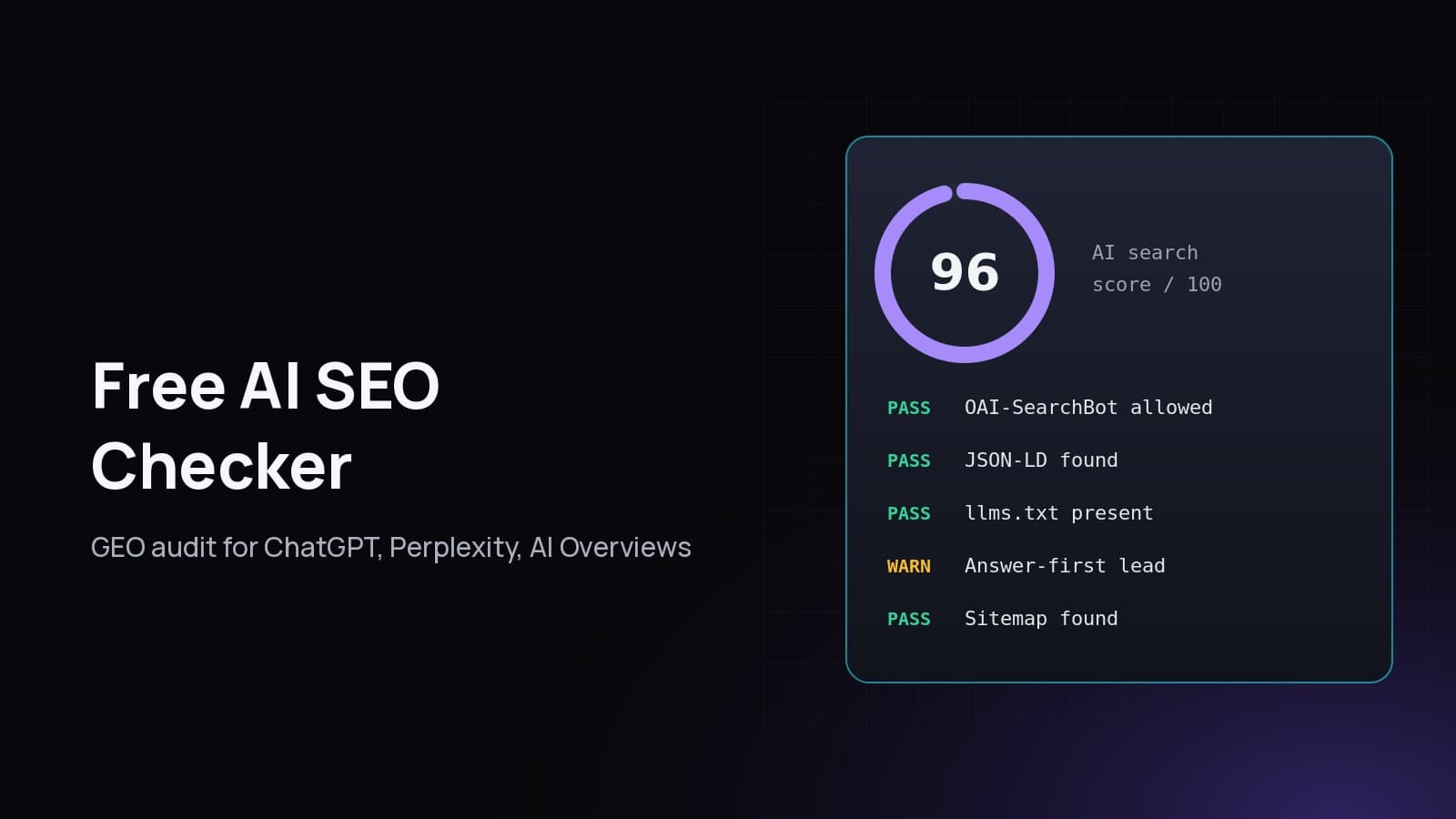
The checker fetches the URL you enter plus its robots.txt, llms.txt and sitemap, then runs a set of checks in three groups: on-page (HTTPS, response time, title, meta description, canonical, Open Graph, headings, answer-first lead), discovery (JSON-LD, llms.txt, sitemap) and AI crawler rules for nine named bots.
Every check, with the weight it carries in the score:
The crawler rows check these user agents: GPTBot, OAI-SearchBot, ChatGPT-User, ClaudeBot, PerplexityBot, Google-Extended, CCBot and Applebot-Extended (expected: allowed), plus Bytespider (expected: blocked, since it is a high-volume scraper rather than a citation crawler). If you deliberately block training bots such as GPTBot or CCBot, that row will fail; the choice is yours, and the tip explains the trade-off.
How is the AI search score calculated?#
The score is a weighted average out of 100. Each check has a weight, and a pass earns its full weight, a warning earns half, and a fail earns nothing. The total earned is divided by the total possible weight and rounded. Discovery checks such as JSON-LD and llms.txt weigh most because they decide whether an engine understands the page at all.
So a page that passes everything except a warning on the answer-first lead loses 4 of 104 possible points and scores around 96. That is what this site scored when I tested the homepage: every check passed except the answer-first lead, which the tool flagged with "The opening text is there, but it is not a short direct answer."
The tool labels the score with a band:
How do I run a GEO audit with the tool?#
Open the AI SEO checker, paste a full public URL, and press Check this URL. In a few seconds you get a score, a pass, warn or fail status for each check, a one-line detail of what was found, and a fix with a link to a longer guide. Fix the fails first, redeploy, and run it again.
Step by step:
- Pick the page that matters most. Usually your homepage, a pricing page or your best article. The audit is per URL, so check key templates separately (home, blog post, product page).
- Paste the full URL, including
https://, into the Page URL field. Only public http and https addresses are accepted. - Run the check. The tool fetches the page, robots.txt, llms.txt and the sitemap, with an 8-second timeout per request.
- Read the score and the groups. On the page covers metadata, headings and the opening answer. Discovery covers JSON-LD, llms.txt and the sitemap. The crawler section lists each AI bot.
- Fix fails first. A blocked OAI-SearchBot or PerplexityBot means those engines cannot read the page at all, which matters more than a long title.
- Fix warnings next. Each row's "How to fix this" link explains the change.
- Re-run after deploying to confirm the score moved. The tool allows a few runs per visitor every 10 minutes.
How do I fix the most common AI SEO failures?#
The most common failures are a robots.txt that blocks AI search crawlers, a missing llms.txt, no JSON-LD, a missing or duplicate meta description, and a page that opens with filler instead of an answer. Each has a small, specific fix, and most take minutes in a modern framework such as Next.js.
A robots.txt that allows AI search crawlers while keeping private paths closed looks like this:
User-agent: *
Allow: /
Disallow: /admin/

User-agent: OAI-SearchBot
Allow: /
Disallow: /admin/

User-agent: PerplexityBot
Allow: /
Disallow: /admin/

User-agent: Bytespider
Disallow: /

Sitemap: https://example.com/sitemap.xml
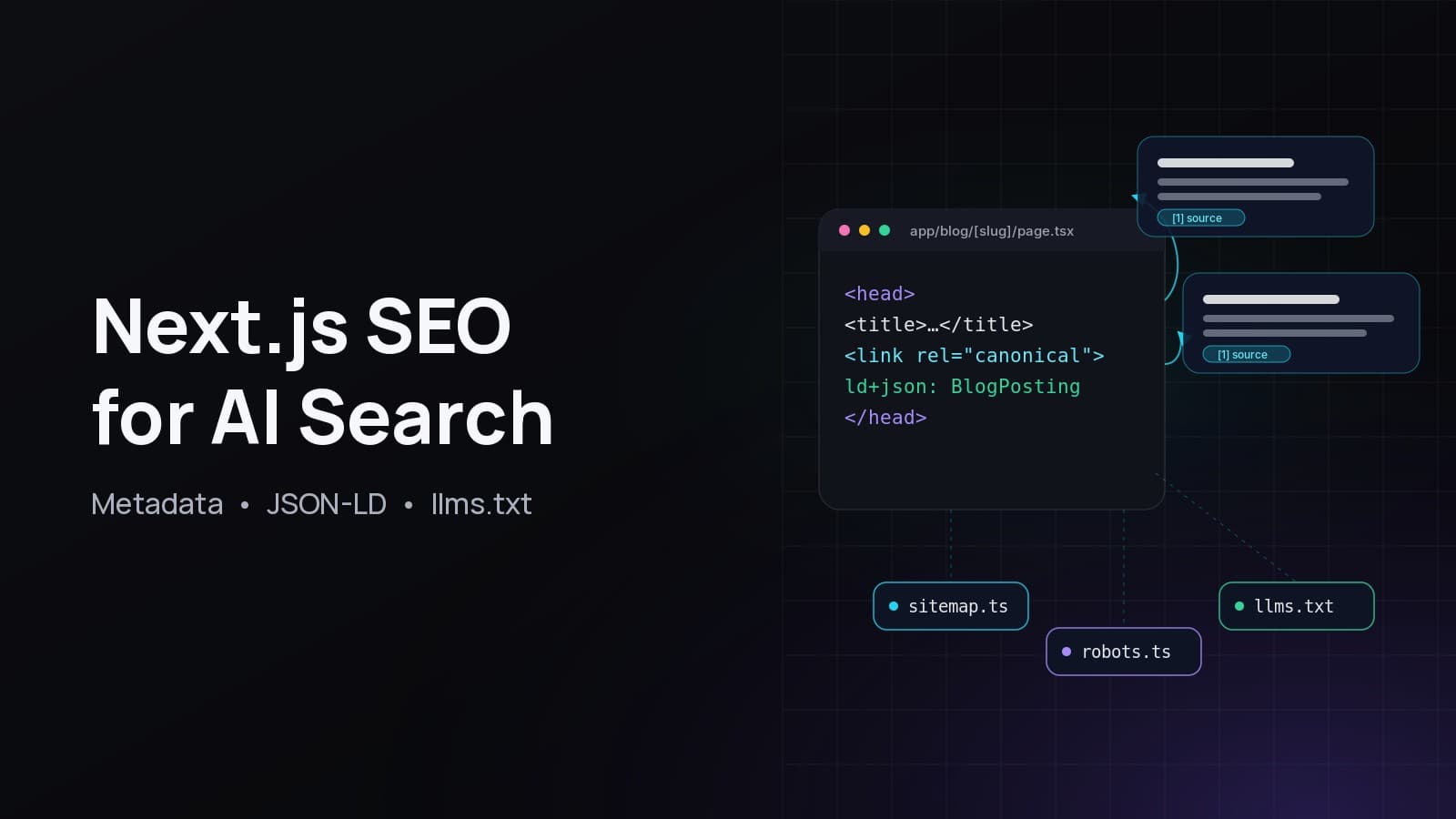
For a full Next.js implementation of robots, sitemap, metadata and JSON-LD, see my guide to Next.js SEO for AI search. For social previews, the free OG image generator makes the og:image the checker looks for.
How do I write content that AI engines cite?#
Write each section so it can be lifted out and quoted on its own: a question as the heading, a direct 40 to 60 word answer first, then detail, tables and steps. Cite primary sources, include concrete numbers you can back up, and define terms plainly. The GEO paper found these citation, quotation and statistics changes gave the biggest gains.
From the GEO paper, in its own benchmark:
The paper also reports that lower-ranked pages gained most: in one test, citing sources raised visibility for pages ranked fifth in search results by 115%. Treat these as research results on a benchmark, not guarantees, but the direction matches what the engines say: clear, sourced, well-structured text wins.
A practical writing checklist:
- A question-style H2 for every main question people ask.
- A first sentence that answers it without preamble.
- One definition per new term.
- At least one comparison table.
- Numbered steps for any process.
- Links to official documentation for every factual claim.
- An FAQ section with short, self-contained answers, marked up as FAQPage if it suits the page.
Is AI SEO different from regular SEO?#
Mostly no. AI search reuses the foundations of regular SEO: crawlable, indexed, fast pages with accurate metadata and helpful content. The differences are emphasis. AI engines quote passages, so answer-first writing, clear sections, cited facts and structured data matter more, and there are extra crawler user agents to allow in robots.txt.
Google notes that traffic from AI Overviews and AI Mode is counted in Search Console's Performance report under the Web search type, so you measure it there alongside normal search.
Frequently asked questions#
Is the AI SEO checker free?#
Yes. The AI SEO checker is free with no account and no email gate. A small rate limit (a few runs per visitor every 10 minutes) keeps it fast and stops abuse.
What is a GEO audit?#
A GEO audit is a review of a page against what generative engines need: crawler access, indexability, metadata, structured data, llms.txt, a sitemap, clear headings and answer-first content. The checker automates the technical part and returns a score with fixes.
Can I guarantee my site appears in ChatGPT or AI Overviews?#
No. No tool or agency can guarantee it. Google states that meeting every requirement does not guarantee crawling, indexing or serving. You can remove the technical blockers and make the content easy to cite, which improves your chances.
Should I block GPTBot?#
It depends on your goals. GPTBot collects training data, while OAI-SearchBot powers ChatGPT search results. OpenAI documents them separately, so you can block GPTBot and still allow OAI-SearchBot if you want to appear in ChatGPT search without contributing training data.
Does llms.txt improve my AI SEO score?#
In this tool, yes: llms.txt is one of the heaviest checks, at 10 points. In the real world, Google says you do not need it for AI Overviews. It helps agents and assistants that read it, and it costs little to add.
How often should I run an AI SEO check?#
Run it after every deploy that touches templates, robots.txt or metadata, and on each new key page. A robots.txt change can silently block an AI crawler, so a quick re-check after infrastructure changes is worth it.
Key takeaways#
- AI SEO starts with access: allow OAI-SearchBot, PerplexityBot and the other bots you want, and remember named robots.txt groups do not inherit
*rules. - Google says no special optimization is needed for AI Overviews; normal SEO fundamentals apply.
- Write answer-first sections with cited sources and real numbers; the GEO paper found these gave the biggest visibility gains, and keyword stuffing did not.
- Add JSON-LD that matches visible text, a sitemap and an llms.txt.
- Audit key pages for free with the AI SEO checker, fix fails first, then re-run.
Run your free AI SEO check#
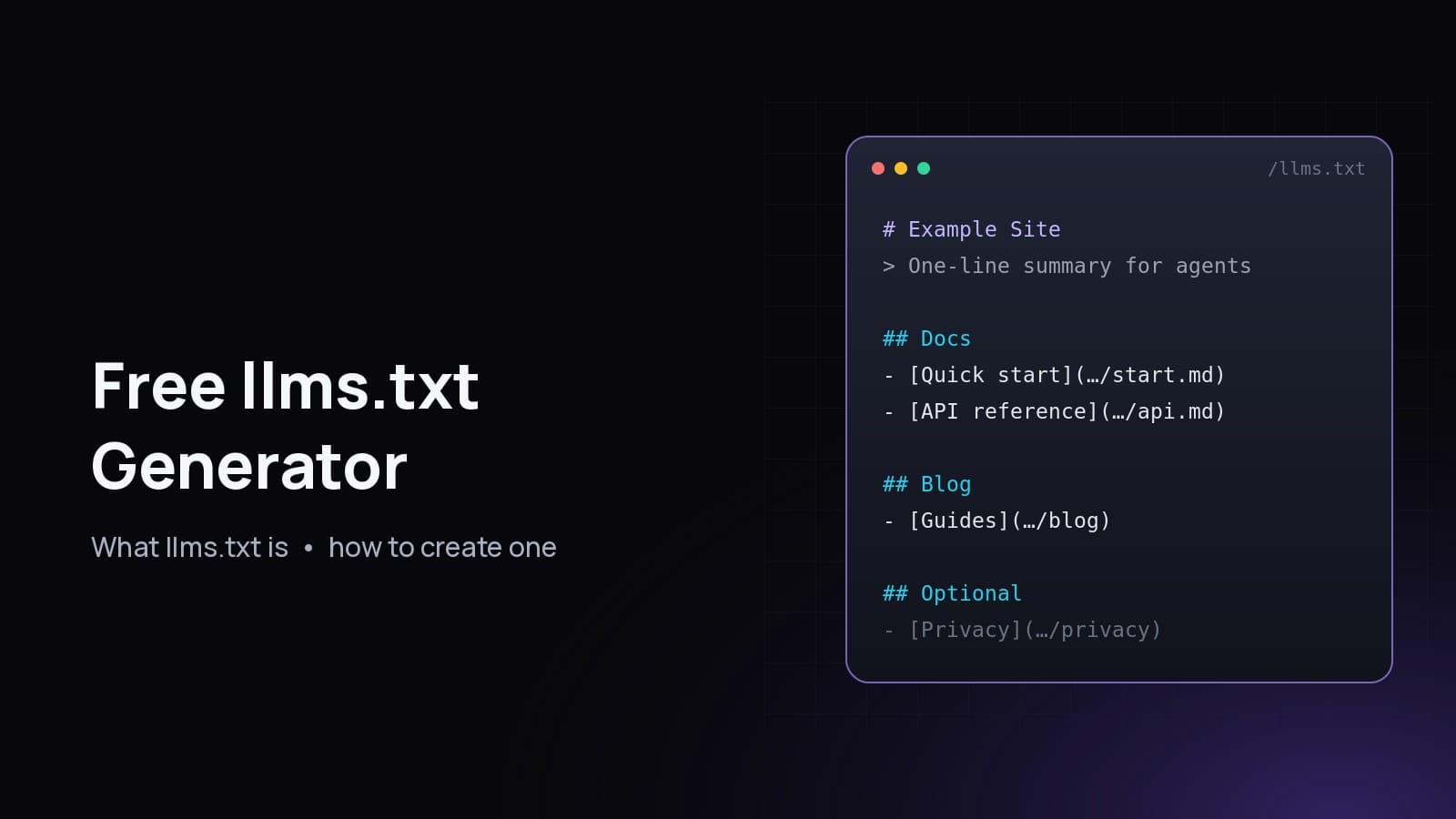
Paste your most important page into the free AI SEO checker and fix the first failure it shows. If llms.txt is missing, make one with the llms.txt generator. All my free tools are on the tools page, and my work is on the projects page.
Questions
Is the AI SEO checker free?
Yes. The AI SEO checker at fabwaseem.com/tools/ai-seo-checker is free with no account or email gate. A small rate limit of a few runs per visitor every 10 minutes keeps it fast.
What is a GEO audit?
A review of a page against what generative engines need: crawler access, indexability, metadata, structured data, llms.txt, a sitemap, clear headings and answer-first content. The checker automates the technical part and returns a score with fixes.
Can I guarantee my site appears in ChatGPT or AI Overviews?
No. Google states that meeting every requirement does not guarantee crawling, indexing or serving. You can remove technical blockers and make content easy to cite, which improves your chances.
Should I block GPTBot?
It depends. GPTBot collects training data, while OAI-SearchBot powers ChatGPT search results. OpenAI documents them separately, so you can block GPTBot and still allow OAI-SearchBot to appear in ChatGPT search.
Does llms.txt improve my AI SEO score?
In this tool, yes: llms.txt is one of the heaviest checks at 10 points. Google says you do not need it for AI Overviews, but it helps agents that read it and costs little to add.
How often should I run an AI SEO check?
After every deploy that touches templates, robots.txt or metadata, and on each new key page. A robots.txt change can silently block an AI crawler.
Share